The Science of QuietTap
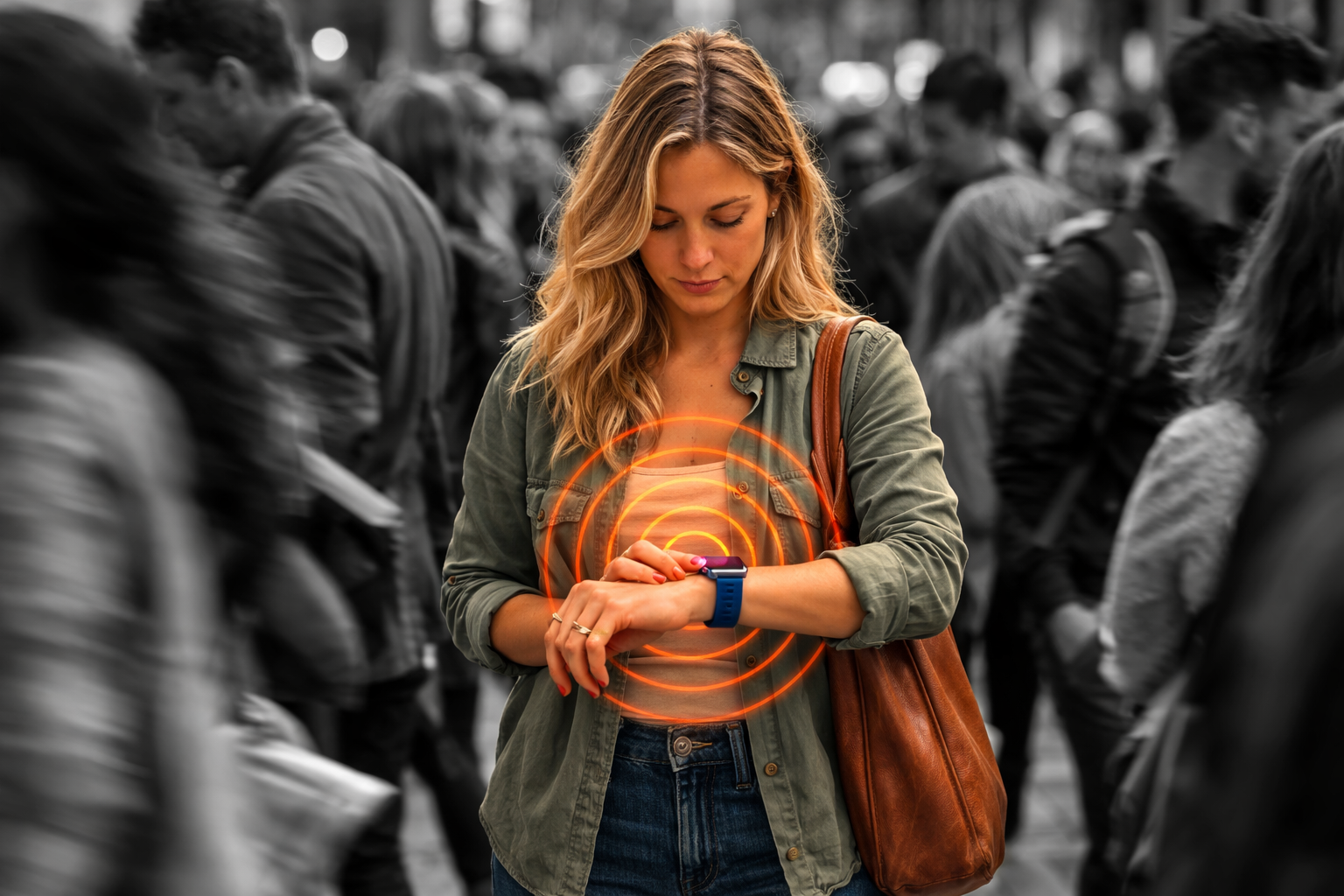
A steady pulse. A quieter mind. Here’s why it works.
When you’re feeling overwhelmed, anxious, or scattered, your nervous system is in a state of high alert — heart racing, thoughts spiralling, body braced for a threat that may not exist. QuietTap gives your nervous system something simple and steady to follow. That’s not just intuition. It’s backed by a growing body of research.
Rhythm as a signal of safety
The nervous system is constantly scanning for cues about whether the environment is safe or dangerous. A slow, predictable rhythm is one of the most reliable signals that things are okay.
Research published in Nature Scientific Reports found that a wrist-worn device delivering slow, heartbeat-like vibrations measurably reduced physiological arousal and lowered self-reported anxiety during a stressful public speaking task — without the wearer needing to do anything active. The rhythm did the work.¹
This effect is known as entrainment — the tendency of biological systems to synchronise with a steady external rhythm. Your heart rate, breathing, and nervous system naturally begin to follow a consistent pulse, pulling your physiology toward calm.
Haptic rhythm and the wrist
A 2025 study developed a smartwatch-based system that delivered rhythmic vibrations set slightly slower than the user’s real-time heart rate. The result: increased parasympathetic nervous system activity — the branch responsible for rest, recovery, and calm — and improved perceived relaxation during short-term use.²
A separate study found that slow haptic pulses on the wrist caused participants to implicitly incorporate the external rhythm as their own, effectively slowing their perceived heart rate and reducing anxiety without conscious effort.³
These findings speak directly to what QuietTap does: a discreet, steady vibration on your wrist or in your hand that your nervous system can lock onto and follow.
What tapping does to the brain
Rhythmic tapping — across a range of therapeutic and informal practices — has a consistent effect on the brain’s threat-detection centre, the amygdala. Research published in Frontiers in Psychology found that rhythmic tapping reduces amygdala activation, lowers cortisol (the primary stress hormone), and shifts the body from sympathetic (“fight or flight”) to parasympathetic (“rest and digest”) dominance.⁴
This isn’t new territory. The database maintained by the Association for Comprehensive Energy Psychology contains over 200 peer-reviewed clinical trials examining rhythmic tapping interventions, including 97 randomised controlled trials — more than 99% of which show statistically significant improvements in at least one targeted symptom.
Heart rate variability: the measure of resilience
One of the clearest physiological markers of a regulated nervous system is heart rate variability (HRV) — the natural fluctuation in time between heartbeats. Higher HRV indicates a flexible, resilient autonomic nervous system. Lower HRV is associated with anxiety, poor stress tolerance, and cardiovascular risk.
Paced rhythmic input — whether from breathing, auditory cues, or haptic feedback — has been shown to reliably increase HRV and vagal tone, the neural pathway through which the brain regulates the heart. A 2024 review confirmed that rhythm-based biofeedback reduces anxiety, improves emotional regulation, and builds long-term stress resilience.⁵
Passive regulation — no effort required
One of the things that makes haptic rhythm distinctly useful is that it works without demanding your attention. Unlike breathing exercises or mindfulness practices that require focus and intention, a steady wrist pulse can guide your physiology toward calm even when your mind is too busy or distressed to actively engage.
Research describes this as pre-conscious emotion regulation — modulating physiological states through non-cognitive pathways, before the thinking brain gets involved.²
This is why QuietTap is useful in moments when meditation feels impossible: during a difficult meeting, on a crowded commute, before a hard conversation, or when anxiety won’t quiet down at 3am.
An honest note
The research on wrist-based haptic pacing is relatively recent — the strongest studies date from 2017 to 2025. This is an emerging evidence base, not decades of large-scale trials. Effects vary between individuals, and people with higher interoceptive awareness (a stronger sense of their own body’s signals) tend to respond more strongly. QuietTap is not a medical device and is not intended to treat or diagnose any condition.
What it is: a simple, evidence-informed tool for nervous system regulation — available whenever you need it, right on your wrist.
Sources
- The calming effect of a new wearable device during the anticipation of public speech — Scientific Reports, Nature (2017)
- Closed-Loop Rhythmic Haptic Biofeedback via Smartwatch for Relaxation and Sleep Onset — arXiv (2025)
- The effect of haptic stimulation simulating heartbeats on physiological responses and stress — Biological Psychology, PubMed (2021)
- How tapping works: physiological and psychological mechanisms in energy psychology — Frontiers in Psychology (2025)
- Harnessing non-invasive vagal neuromodulation: HRV biofeedback and autonomic regulation — PMC (2025)
 QuietTap